Druid
Druid — The Encounter
Feathered shaman of the wild, who speaks for beast and storm · a boss your table can run with almost no prep. SRD 5.1-compatible.
Who Is Druid
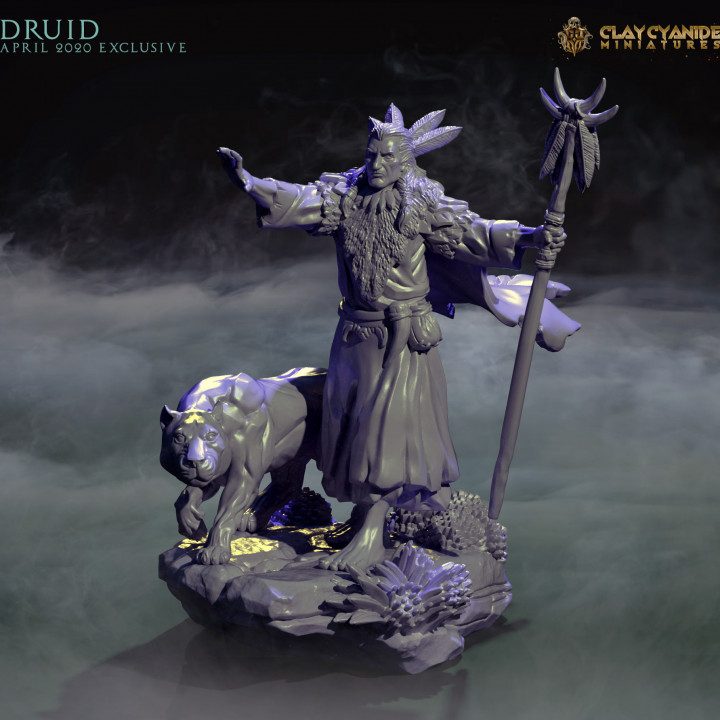
They call him the Feather-Spoken, for the wild answers when he speaks. Folk of the high pine country say he was a hunter once, until a winter spent dying in the snow taught him the tongues of the beasts that watched him freeze — and did not eat. He rose with their voices in his chest. Now he keeps the old covenant: that no grove be felled, no spring be fouled, no creature slain past need. His staff is cut crescent like the moon he answers to, hung with the feathers of birds he has wept over. The panther at his heel is no servant but a sworn brother, and they share one sight, one anger. When loggers, poachers, or fire-bringers cross into his wards, he calls the lightning down and lets the thornbrake close behind them. Travelers who keep the covenant find their paths cleared, their wounds knit, and a great cat walking the dark just beyond the firelight — watching, but never hungry.
Run Druid in Sixty Seconds
- He is a controller, not a brawler. Open the fight by shaping the battlefield — entangle, spike growth, or moonbeam — then make the party come to him through the hazard.
- Kill the panther first. Beast Bond and Shielding Lunge make the pair far tougher together; drop the cat and the druid loses his damage rider and his bodyguard.
- When bloodied, he runs. Wild Step lets him disengage through difficult terrain every round — chase him into his own spike growth and you bleed for it.
- Three ways to run him: a lone grove-warden ambushing trespassers (drop a tier), the warband caster behind a beast-pack, or the controller in a lair boss's room shaping the floor for the real threat.
- Save your reaction for Wild Step. The 2d6 thorns plus a free half-move out of melee is his whole survival plan — don't waste it.
Druid
Medium humanoid (human), neutral good
CR 6 · 2,300 XP · GUIDELINESpellcasting. The druid casts using Wisdom (spell save DC 15, +7 to hit). It has the following spells prepared: cantrips — druidcraft, produce flame, shillelagh; 1st — cure wounds, entangle, faerie fire, thunderwave; 2nd — flaming sphere, moonbeam, spike growth; 3rd — call lightning, conjure animals, sleet storm.
Beast Bond. Signature. While the druid's bonded beast (its companion) is within 60 feet and conscious, the druid can see through the beast's eyes and the beast adds the druid's Wisdom modifier (+4) to its damage on the first hit each turn. If the beast drops to 0 hit points, the druid can use its reaction to grant it 10 temporary hit points (once per short rest).
Actions
Multiattack. The druid makes two melee attacks with its staff, or casts a cantrip and makes one staff attack.
Crescent Staff (with shillelagh). Melee Weapon Attack: +7 to hit, reach 5 ft., one target. Hit: 12 (2d8+4) bludgeoning damage, and the target must succeed on a DC 15 Constitution saving throw or be unable to take reactions until the end of its next turn.
Produce Flame. Ranged Spell Attack: +7 to hit, range 30 ft., one target. Hit: 11 (2d8+2) fire damage.
Bonus Actions & Reactions
Wild Step (Reaction). When the druid would be hit by an attack, it can wreathe itself in thorned brambles. The attacker takes 7 (2d6) piercing damage, and the druid moves up to half its speed without provoking opportunity attacks.
A weather-browned shaman crowned in eagle feathers raises one open hand to call the storm while his crescent-bladed staff hums with green light; a great panther pads from the brush at his side, eyes fixed on the same prey.
Druid, Bound
Companion · acts on your initiative
Bound · GUIDELINEPack Hunter (signature). The panther has advantage on attack rolls against any creature within 5 feet of the druid or another of the druid's allies.
Actions
Pounce Bite. Melee Weapon Attack: +6 to hit, reach 5 ft., one target. Hit: 13 (2d8+4) piercing damage. If the panther moved at least 20 feet straight toward the target before the hit, the target must succeed on a DC 14 Strength save or be knocked prone.
Reactions
Shielding Lunge. When the druid within 10 feet is targeted by an attack, the panther can interpose, becoming the new target of that attack.
A sleek black panther, scarred and silent, that hunts as a thought shared with its bonded druid rather than a beast led on a leash.
Guideline numbers — formula-tuned and read from the miniature's design, not yet table-proven. Tell us how it ran in the comments.
How It Fights — by Tier
Same creature, scaled threat. The traits never change; only the numbers move.
Open with entangle on the clustered party, then hang back and pelt with produce flame while the panther flanks. If a frontliner closes, hit with the staff and use Wild Step to peel away. Pair the druid with a treant or a beast-pack boss — he is a support caster, not a centerpiece.
Open with conjure animals or moonbeam, then drop spike growth across the choke so melee PCs eat damage reaching him. Kill-priority: the panther, since Beast Bond and Shielding Lunge make the pair durable together. If bloodied, retreat through difficult terrain with Wild Step and call lightning from range. Best fielded with minions or a lair, leading a beast-warden warband rather than fighting alone.
Open with sleet storm to blind the casters, then call lightning round after round while the panther and summoned beasts pin the front line. Focus the panther first to break Beast Bond. Pair him with a bigger threat — an ancient guardian beast or storm-spirit boss — with the druid as the lair's controller, not a solo.
Put Druid on the table
Download the presupported STL and run the fight tonight — the model, and the encounter that comes with it.
Get the STL on MyMiniFactory →Clay Cyanide Companion Rules v1
How a bound creature acts
- A companion acts on its owner's initiative, immediately after the owner.
- It uses the Companion block above — roughly ×0.6 HP and damage, no recharge abilities, and at most one reaction trait.
- It moves freely; it takes its Action only while its owner is conscious.
- At 0 HP a companion is broken, not dead — restored on a long rest unless your table rules otherwise.
Original Clay Cyanide material © Clay Cyanide LLC — explicitly not the non-SRD official sidekick rules.
Questions, Asked at the Table
What CR is Druid?
Natively CR 6 (Tier 2, ~levels 5–10): AC 15, 119 HP, +7 to hit, save DC 15. The record also gives drop-in CR 2 (Tier 1) and CR 11 (Tier 3) lines so you can field him at any table without rebuilding the block.
Can Druid be a companion or ally?
Yes. As an ally he is a superb support caster — cure wounds, faerie fire, and conjure animals turn a party fight in your favor, and his bonded panther adds a second body to the line. Run him as a hireling guide, a grove-guardian who aids those who keep the covenant, or a recurring NPC who fights beside the heroes against poachers and fire-bringers.
Is the druid solo-capable?
No — he has no legendary actions and a single reaction, so a four-PC party will out-act him. He shines as a controller backing a flagship boss or leading a warband of beasts and minions; field him with a bigger threat rather than as the centerpiece.
Tell Us How It Ran
This work includes material taken from the System Reference Document 5.1 ("SRD 5.1") by Wizards of the Coast LLC and available at dnd.wizards.com/resources/systems-reference-document. The SRD 5.1 is licensed under the Creative Commons Attribution 4.0 International License available at creativecommons.org/licenses/by/4.0/legalcode.
Clay Cyanide Miniatures is not affiliated with, endorsed, sponsored, or specifically approved by Wizards of the Coast LLC. This content is compatible with the fifth edition of the world's most popular fantasy roleplaying game. Companion rules, lore, names, and original mechanics © Clay Cyanide LLC.
Technical Specifications
32mm, 75mm
STL, Pre-supported STL
Standard or ABS-like resin, 0.05mm layer height
Yes — ready to print, optimized supports included
Played Druid at your table? Log in with your Obsidian Tavern account to leave a balance note, a war story, or a file issue — the sharpest reports get the block revised.
Log in to comment