Quake
Quake — The Encounter
The walking siege-engine that wakes the ground itself · a boss your table can run with almost no prep. SRD 5.1-compatible.
Who Is Quake
The smiths of the old foundry-cults swore that a body of iron, properly bound and balanced, could hold a fragment of will the way a forge holds heat. Quake is the proof and the warning. Built to break walls and walk through siege-lines unmoved, it carries the weight of a small house in its legs alone, and the ground answers every footfall with a tremor. The babylonian and Rhodian artificers of legend dreamed of bronze men who guarded harbors and tombs; Quake is their grim industrial heir, stripped of grace and given only the single-minded patience of stone. It does not tire, does not fear, and does not stop. Those who have stood against it describe not a duel but a demolition: the slow, certain advance of something that was made to outlast the men who fight it. When its maker's command runs dry, it simply keeps walking, flattening whatever stands between it and the last order it was given.
Run Quake in Sixty Seconds
- Hold Quake is a slow wall of metal — it has no ranged attack, so let the party come to it or march it relentlessly toward whatever it was ordered to break.
- Open with Ground Slam if two or more PCs are within 15 feet; otherwise Concussion Gauntlet to knock one prone, then Slam them where they lie.
- Kill-priority the nearest reachable body — Quake cannot chase flyers or kiters, so make every PC it can touch pay for standing in melee.
- Three ways to run it: (1) the anvil — pin the party in place while a sniper or boss does the killing; (2) the breacher — point it at a door, wall, or objective and let it demolish; (3) the bodyguard — keep it within reach of a fragile commander and let Bracing Stance soak the alpha strike.
Quake
Large construct, lawful neutral
CR 6 · 2,300 XP · GUIDELINESeismic Tread. Quake's footfalls fracture stone. Difficult terrain made of earth, rubble, or worked stone does not slow its movement, and the ground within 10 feet of it is difficult terrain for other creatures.
Siege Frame. Quake deals double damage to objects and structures, and ignores the first 5 points of damage from any single source that is not magical.
Actions
Multiattack. Quake makes two attacks: one with its Slam and one with its Concussion Gauntlet.
Slam. Melee Weapon Attack: +8 to hit, reach 10 ft., one target. Hit: 18 (3d8+5) bludgeoning damage.
Concussion Gauntlet. Melee Weapon Attack: +8 to hit, reach 5 ft., one target. Hit: 14 (2d8+5) bludgeoning damage, and the target must succeed on a DC 15 Strength saving throw or be knocked prone and pushed 10 feet away.
Ground Slam (Recharge 5-6). Quake drives both fists into the earth. Each creature within 15 feet must make a DC 15 Dexterity saving throw, taking 22 (4d10) bludgeoning damage and being knocked prone on a failed save, or half damage and not knocked prone on a success. The ground in the area becomes difficult terrain until the start of Quake's next turn.
Bonus Actions & Reactions
Bracing Stance. Reaction — When Quake is hit by an attack, it can lock its pistons and plant its feet, gaining a +3 bonus to AC against that attack and becoming immune to forced movement until the start of its next turn.
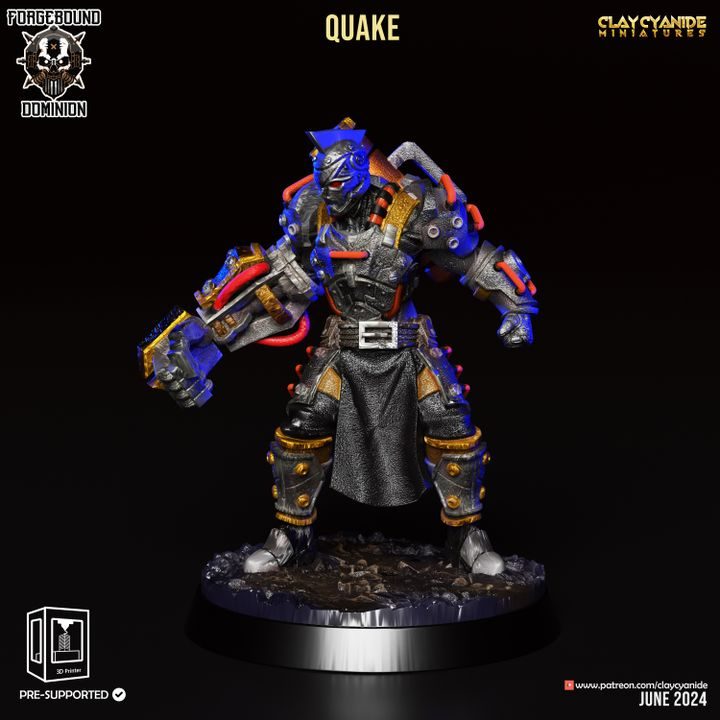
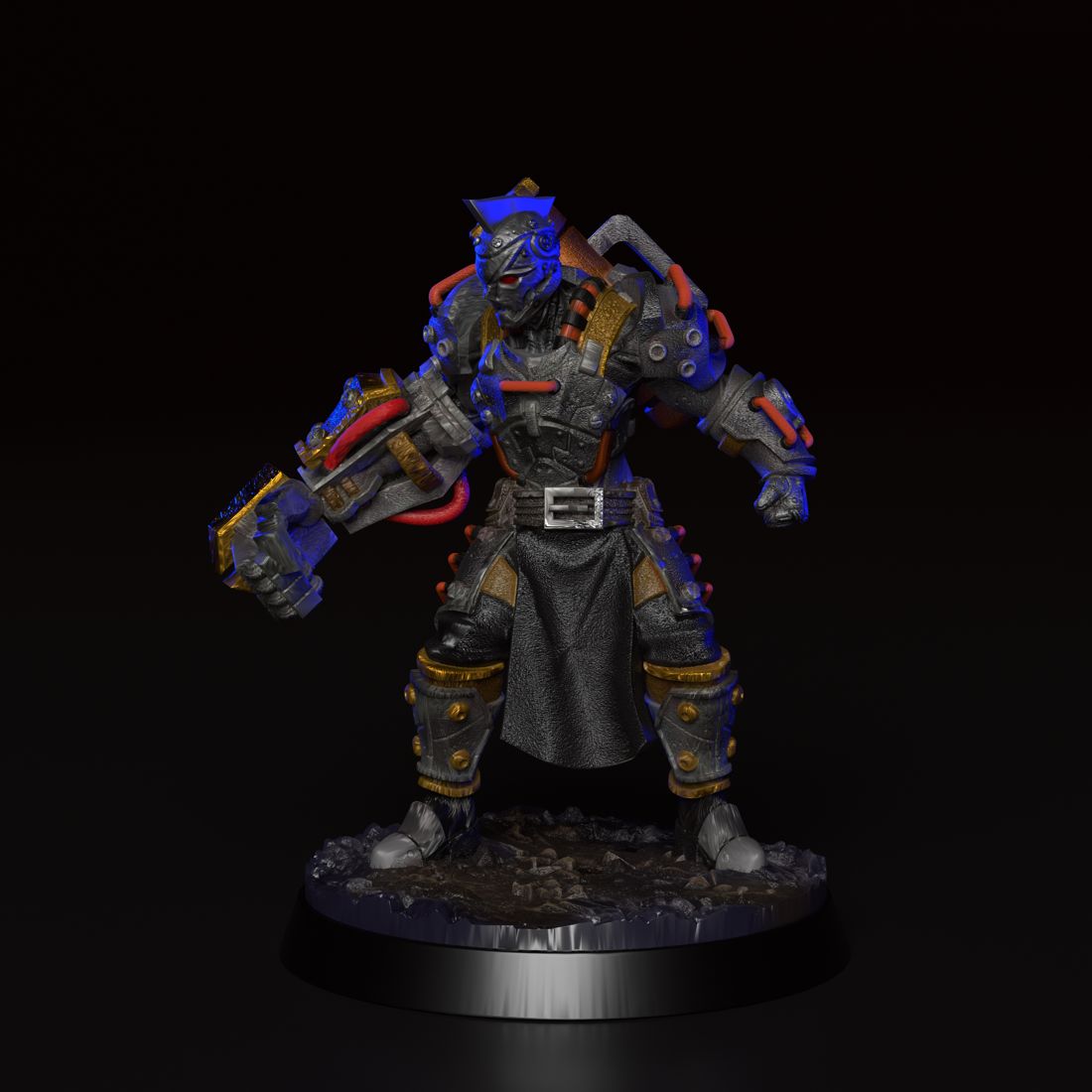
A man-shaped war-engine of riveted blue and gold plate, hydraulic veins venting steam, one arm ending in a blocky concussion gauntlet. Each step it takes leaves a cracked footprint in stone.
Quake, Bound
Companion · acts on your initiative
Bound · GUIDELINEStabilizing Anchor (signature). While within 10 feet of Quake, allies cannot be knocked prone by an enemy's forced movement, and Quake itself has advantage on saving throws against being knocked prone.
Actions
Piston Hammer. Melee Weapon Attack: +6 to hit, reach 5 ft., one target. Hit: 13 (2d8+4) bludgeoning damage.
Reactions
Take the Blow. Reaction — When an ally Quake can see within 5 feet is hit by an attack, Quake can interpose its frame, taking the damage instead.
A squat, broad-shouldered partner-frame built to brace and absorb, Quake plants itself beside its larger kin and refuses to be moved.
Guideline numbers — formula-tuned and read from the miniature's design, not yet table-proven. Tell us how it ran in the comments.
How It Fights — by Tier
Same creature, scaled threat. The traits never change; only the numbers move.
Open with the Concussion Gauntlet to shove a frontliner prone, then Slam them while they're down. Save Ground Slam for when two or more PCs cluster around it. Pair it with a caster or commander it must protect; it is a wall, not a duelist.
Open by walking straight into the cluster and using Ground Slam to scatter the party prone, then Multiattack the nearest target. Kill-priority: anyone who can fly or kite it — Quake has no answer to range, so it crushes whoever it can reach. Use Bracing Stance against the biggest hit each round. Best fielded as the anvil while archers or a boss serve as the hammer.
Run it as the breaching unit in a larger assault — pair it with a bigger threat or a squad of minions that punish anyone who backs off the line. Lead with Ground Slam into the densest cluster, then Multiattack the prone. It excels in tight corridors and lair fights where the party can't simply outrange it.
Put Quake on the table
Download the presupported STL and run the fight tonight — the model, and the encounter that comes with it.
Get the STL on MyMiniFactory →Clay Cyanide Companion Rules v1
How a bound creature acts
- A companion acts on its owner's initiative, immediately after the owner.
- It uses the Companion block above — roughly ×0.6 HP and damage, no recharge abilities, and at most one reaction trait.
- It moves freely; it takes its Action only while its owner is conscious.
- At 0 HP a companion is broken, not dead — restored on a long rest unless your table rules otherwise.
Original Clay Cyanide material © Clay Cyanide LLC — explicitly not the non-SRD official sidekick rules.
Questions, Asked at the Table
What CR is Quake?
Quake's home tier is CR 6 (Tier 2, party levels 5-10): AC 17, 136 HP, +8 to hit, save DC 15. Stat blocks for Tier 1 (~CR 2) and Tier 3 (~CR 11) are provided above — the traits and actions stay identical, only the numbers move.
Can Quake be a companion or ally?
Yes. The bound partner-frame Tamp (AC 16, 82 HP) is built to brace and shield — its Stabilizing Anchor keeps nearby allies on their feet and Take the Blow lets it eat a hit meant for a friend. Run it as a steadfast guardian for a player or NPC.
Is Quake immune to being knocked around or shut down?
As a construct it's immune to poison, psychic damage, and to being charmed, frightened, paralyzed, poisoned, or exhausted. It is not immune to forced movement by default, but Bracing Stance can lock it in place for a round, and Seismic Tread means rough ground never slows it.
Tell Us How It Ran
This work includes material taken from the System Reference Document 5.1 ("SRD 5.1") by Wizards of the Coast LLC and available at dnd.wizards.com/resources/systems-reference-document. The SRD 5.1 is licensed under the Creative Commons Attribution 4.0 International License available at creativecommons.org/licenses/by/4.0/legalcode.
Clay Cyanide Miniatures is not affiliated with, endorsed, sponsored, or specifically approved by Wizards of the Coast LLC. This content is compatible with the fifth edition of the world's most popular fantasy roleplaying game. Companion rules, lore, names, and original mechanics © Clay Cyanide LLC.
Technical Specifications
32mm, 75mm
STL, Pre-supported STL
Standard or ABS-like resin, 0.05mm layer height
Yes — ready to print, optimized supports included

Played Quake at your table? Log in with your Obsidian Tavern account to leave a balance note, a war story, or a file issue — the sharpest reports get the block revised.
Log in to comment