Chaos Dragon
Chaos Dragon — The Encounter
Primordial wyrm clad in mutating spines of raw chaos · a boss your table can run with almost no prep. SRD 5.1-compatible.
Who Is Chaos Dragon
Before the first laws bound the world, chaos churned, and from that churning crawled the spine-wracked wyrms — dragons born not of egg and lineage but of unmade matter that refused to settle into form. The Chaos Dragon is such a thing. Its scales grow and slough in the span of a breath; its bones reshape; the venom in its throat is never twice the same, now acid, now frost, now ember, now the white scream of lightning. Sages who survived its passing wrote that it could not be poisoned, for it had no fixed flesh to corrupt, nor terrified, for it knew nothing it might lose. It hunts not from hunger but from the old instinct of unmaking: every ordered thing it sees — a wall, a kingdom, a name — is an affront to the formless deep that birthed it. Those who hear the irregular thunder of its mismatched wings learn quickly that there is no preparing for a foe that changes the rules each time it breathes.
Run Chaos Dragon in Sixty Seconds
- Roll the d4 first. At the top of each dragon turn, set its damage type (1 acid / 2 cold / 3 fire / 4 lightning) before anything else — this drives both the Bite rider and Chaos Breath.
- Open from the air. Lead with Chaos Breath on the tightest cluster (DC 17 Dex, 49 in a 60-ft cone), then land into Multiattack on the nearest soft target.
- Kill-priority: healers and casters. The dragon is INT 16 and patient — it spends Bite and legendary Claws on whoever keeps the party standing.
- When bloodied (104 HP), go airborne. Use Wing Buffet (2 legendary actions) to knock the melee line prone and reposition out of reach, then breathe again on recharge.
- Three ways to run it: a fleeing wyrmling that strafes a low party; a patient mid-tier ambusher leaning on shifting damage types; or the full T3 boss with legendary actions and the Lashing Tail reaction punishing anyone who steps close.
Chaos Dragon
Huge dragon (chaotic), chaotic evil
CR 11 · 7,200 XP · GUIDELINEMutating Form. The dragon's body is never twice the same. At the start of each of its turns, roll a d4 to determine the damage type of its breath weapon and bite for that round: 1 acid, 2 cold, 3 fire, 4 lightning. A creature cannot gain advance warning of which it will use.
Chaotic Resilience. Whenever the dragon takes damage of a type, it gains resistance to that damage type until the end of its next turn. It cannot have resistance to more than one type at a time — the newest hit overwrites the last.
Legendary Resistance (2/Day). If the dragon fails a saving throw, it can choose to succeed instead.
Actions
Multiattack. The dragon makes three attacks: one with its Bite and two with its Claws. It can replace the Bite with a use of Chaos Breath if available.
Bite. Melee Weapon Attack: +9 to hit, reach 10 ft., one target. Hit: 17 (2d12+6) piercing damage plus 7 (2d6) damage of the type set by Mutating Form.
Claw. Melee Weapon Attack: +9 to hit, reach 5 ft., one target. Hit: 13 (2d8+6) slashing damage.
Chaos Breath (Recharge 5–6). The dragon exhales raw chaos in a 60-foot cone. Each creature in that area makes a DC 17 Dexterity saving throw, taking 49 (14d6) damage of the type set by Mutating Form on a failed save, or half as much on a success.
Bonus Actions & Reactions
Lashing Tail. Reaction. When a creature the dragon can see moves within 10 feet of it, the dragon makes a tail attack against that creature: +9 to hit, reach 10 ft., 13 (2d8+6) bludgeoning damage and the target must succeed on a DC 16 Strength save or be knocked prone.
Legendary Actions (3/Round)
Detect. The dragon makes a Wisdom (Perception) check.
Claw Attack. The dragon makes one Claw attack.
Wing Buffet (Costs 2 Actions). The dragon beats its spiked wings. Each creature within 10 feet makes a DC 17 Dexterity saving throw, taking 13 (2d8+4) bludgeoning damage and being knocked prone on a failure. The dragon can then fly up to half its speed.
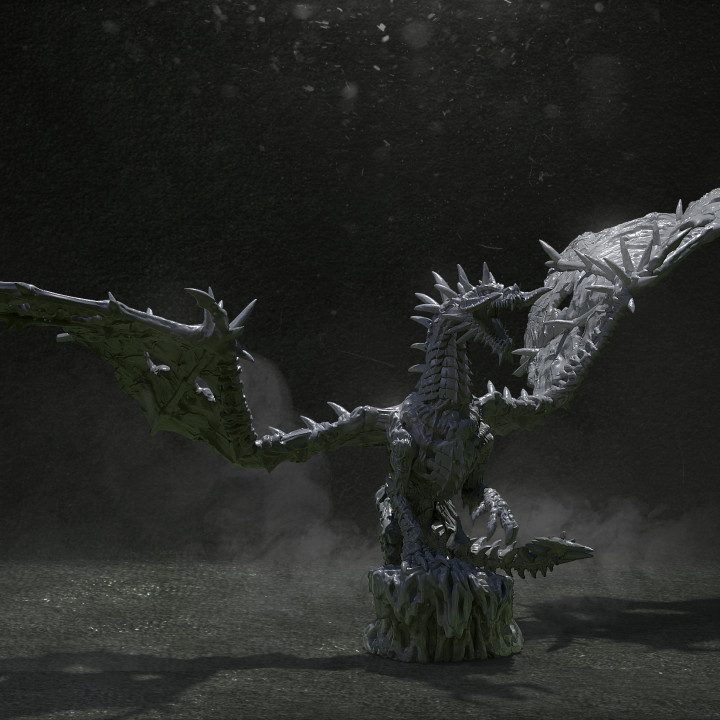
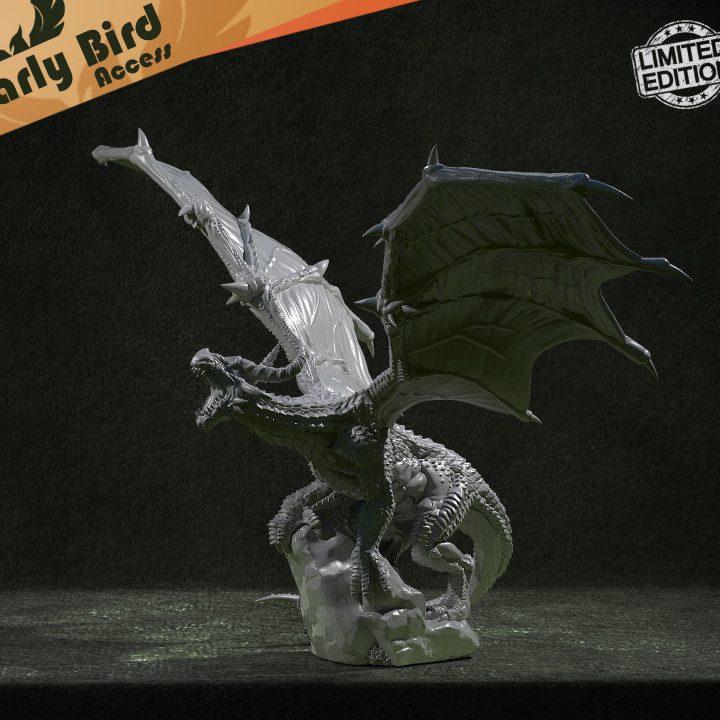
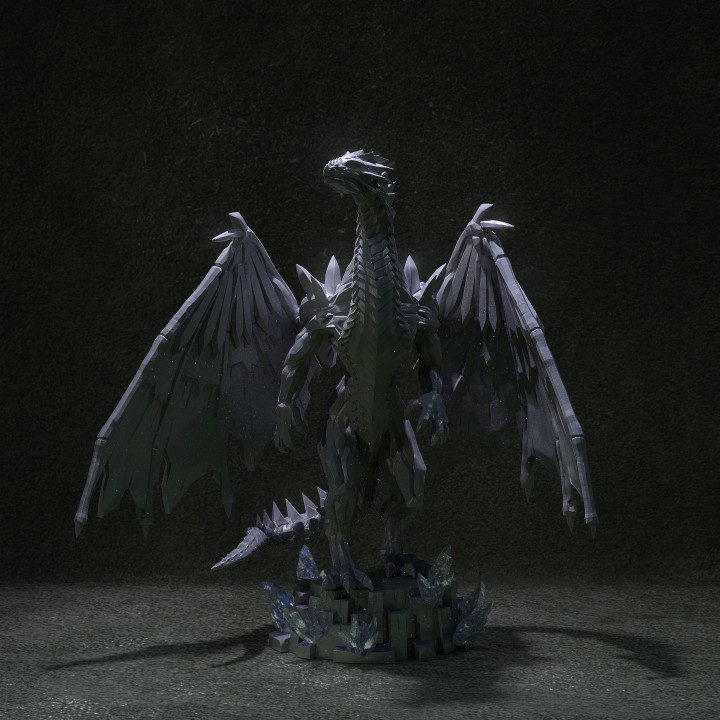
Perched atop a shattered crag with wings flung wide, the wyrm bristles with asymmetric, ever-shifting spines — a body that mutates faster than any eye can map. It does not roar for show; it coils, focused, an apex predator that has outlived the civilizations it devoured.
Chaos Dragon, Bound
Companion · acts on your initiative
Bound · GUIDELINEUnstable Hide (signature). When the sliverling is hit by a weapon attack, the attacker takes 5 (2d4) damage of a random type (acid, cold, fire, or lightning).
Actions
Rending Bite. Melee Weapon Attack: +6 to hit, reach 5 ft., one target. Hit: 11 (2d6+4) piercing damage.
Reactions
Shield the Brood. When the Chaos Dragon within 10 feet is hit by an attack, the sliverling can interpose itself, taking the damage instead.
A half-formed offshoot of the wyrm's mutating flesh, this lesser drake hurls itself between threats and its progenitor, its skin sloughing unstable energies with every blow.
Guideline numbers — formula-tuned and read from the miniature's design, not yet table-proven. Tell us how it ran in the comments.
How It Fights — by Tier
Same creature, scaled threat. The traits never change; only the numbers move.
Run it as a fleeing wyrmling: open with Chaos Breath from the air, then strafe and stay out of reach. If the party clusters, breath first; otherwise dive on the lowest-HP target. Pair it with a couple of sliverlings so a level-3 party feels hunted, not curb-stomped.
Lead with Chaos Breath on the densest knot, then Multiattack the squishiest PC. Kill-priority is healers and casters — it is smart and patient. When bloodied it goes airborne and uses Wing Buffet equivalents to scatter the front line; let the Mutating Form damage type keep the party guessing on resistances.
Centerpiece boss — open with Chaos Breath, then Multiattack the most exposed PC and burn legendary Claw Attacks between turns. Punish anyone who closes with Lashing Tail (prone). Kill-priority is healers; when bloodied, use Wing Buffet to knock the melee prone and reposition. Its breath type rerolls every round, so wide-spectrum resistances won't save them.
Put Chaos Dragon on the table
Download the presupported STL and run the fight tonight — the model, and the encounter that comes with it.
Get the STL on MyMiniFactory →Clay Cyanide Companion Rules v1
How a bound creature acts
- A companion acts on its owner's initiative, immediately after the owner.
- It uses the Companion block above — roughly ×0.6 HP and damage, no recharge abilities, and at most one reaction trait.
- It moves freely; it takes its Action only while its owner is conscious.
- At 0 HP a companion is broken, not dead — restored on a long rest unless your table rules otherwise.
Original Clay Cyanide material © Clay Cyanide LLC — explicitly not the non-SRD official sidekick rules.
Questions, Asked at the Table
What CR is Chaos Dragon?
Its home build is CR 11 (Tier 3, levels 11-15) as a solo centerpiece boss — the band-drop reflects its legendary actions and Lashing Tail reaction letting it out-act a four-PC party. Scaled stat blocks are also provided for Tier 1 (levels 1-4) and Tier 2 (levels 5-10), so you can drop it into almost any table.
Can Chaos Dragon be a companion or ally?
The wyrm itself is far too willful and destructive to befriend, but the Sliverling, Chaos-Spawned — a half-formed offshoot of its mutating flesh — makes a serviceable bound ally with 124 HP, an unstable hide that punishes attackers, and a reaction to shield those near it.
How do I make the fight feel genuinely chaotic at the table?
Don't pre-announce the damage type — roll the d4 openly each round and describe the breath changing color and texture as it comes. Lean on Chaotic Resilience so a party that committed to fire damage suddenly finds the dragon shrugging it off, forcing them to adapt mid-fight rather than rely on one resistance plan.
Tell Us How It Ran
This work includes material taken from the System Reference Document 5.1 ("SRD 5.1") by Wizards of the Coast LLC and available at dnd.wizards.com/resources/systems-reference-document. The SRD 5.1 is licensed under the Creative Commons Attribution 4.0 International License available at creativecommons.org/licenses/by/4.0/legalcode.
Clay Cyanide Miniatures is not affiliated with, endorsed, sponsored, or specifically approved by Wizards of the Coast LLC. This content is compatible with the fifth edition of the world's most popular fantasy roleplaying game. Companion rules, lore, names, and original mechanics © Clay Cyanide LLC.
The Legend
In Your Campaign
CR Range: 15-24 (adult to ancient)
Encounter Design: Chaos Dragon should dominate the encounter space. Use lair actions, legendary actions, and environmental hazards. The party doesn't just fight the dragon — they fight the dragon's domain.
Campaign Hooks: A dragon whose hoard contains something the party desperately needs. A dragon who is the lesser evil compared to what it's guarding against. A dragon who wants to negotiate.
Technical Specifications
32mm, 75mm
STL, Pre-supported STL
Standard or ABS-like resin, 0.05mm layer height
Yes — ready to print, optimized supports included
From the Same Collection

Frequently Asked Questions
What scale is the Chaos Dragon miniature available in?
Chaos Dragon is available in 32mm (tabletop standard) and 75mm (display/collector scale). Both scale files are included with presupported and unsupported STL options.
Is the Chaos Dragon STL file presupported?
Yes. Every Clay Cyanide miniature includes presupported STL files optimized for resin printing at 0.05mm layer height, plus unsupported files for custom support placement.
Can I use Chaos Dragon in my D&D or tabletop RPG campaign?
Absolutely. Chaos Dragon is designed for tabletop gaming at 32mm scale, fitting standard grid-based combat systems. The dynamic pose and detailed sculpt create memorable encounters and character moments.
Played Chaos Dragon at your table? Log in with your Obsidian Tavern account to leave a balance note, a war story, or a file issue — the sharpest reports get the block revised.
Log in to comment