Elront
Elront — The Encounter
Half-Elven Lord, Keeper of the Last Haven · a boss your table can run with almost no prep. SRD 5.1-compatible.
Who Is Elront
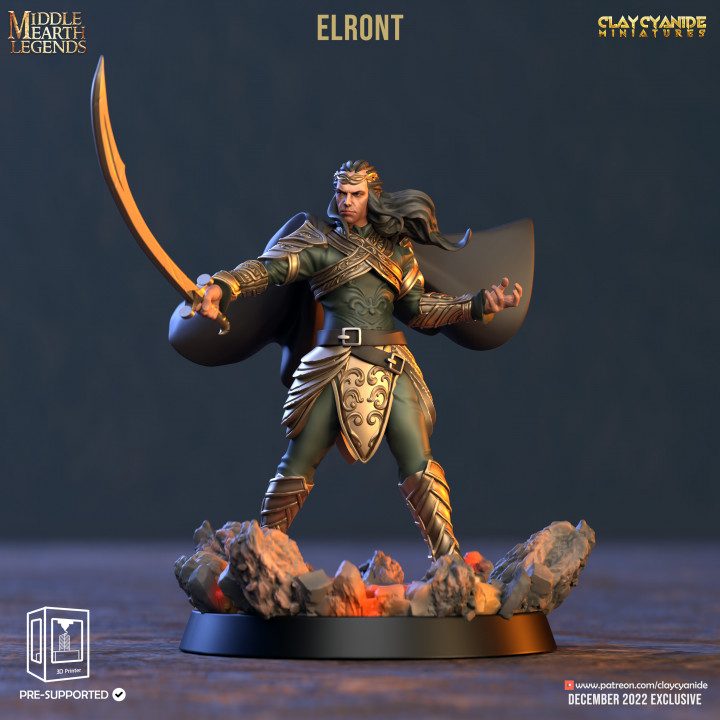
In the old reckonings he is named the Half-Elven, last warden of a hidden valley-haven where the weary and the hunted have always found sanctuary. Of mingled mortal and fair-folk blood, he has outlived kingdoms and counsels, and the wisdom in his grey eyes is older than the thrones that seek his aid. He bears a curved blade forged in an age now drowned, its runes singing only when drawn against the shadow. The folk-tales hold that no charm can cloud his mind and no weariness close his eyes in battle, for the deathless grace of the fair folk runs in him still. When he takes the field he fights as the elder lords once did, in the bladesong, weaving sword-stroke and spell into a single unbroken motion. He does not seek war, but when the dark gathers at his borders he answers it with a quiet, terrible courtesy, and the haven endures another age because of it.
Run Elront in Sixty Seconds
- Hold his reactions — Parrying Ward and Shield can each turn one hit into a miss; spend them on the attack that would actually drop him, not the first that lands.
- Open with haste (or greater invisibility at high tier), then Multiattack the heaviest melee threat; Bladesong adds 2d8 force the turn after he casts.
- Kill-priority is enemy spellcasters and anyone menacing his allies — counterspell their first big spell, then duel them down.
- When bloodied, Misty Step to cover and parry the retaliation rather than trading blows; he is a fencer, not a wall.
- Three ways to run him: noble ally who joins the party, elite rival duelist guarding a haven, or duelist-lieutenant beside a bigger flagship boss — he is an add-on, never the lone centerpiece.
Elront
Medium humanoid (elf), lawful good
CR 6 · 2,300 XP · GUIDELINEFey Ancestry. Elront has advantage on saving throws against being charmed, and magic can't put him to sleep.
Bladesong. (signature) While Elront wields a sword in one hand and has the other free, his graceful battle-dance grants him +1 AC (included above), and the first time he is missed by a melee attack each turn he may immediately move 10 ft. without provoking opportunity attacks. When he casts a spell of 1st level or higher, his next weapon attack before the end of his turn deals an extra 9 (2d8) force damage.
Actions
Multiattack. Elront makes two attacks with his Elven Blade, or one with his blade and casts a cantrip.
Elven Blade. Melee Weapon Attack: +7 to hit, reach 5 ft., one target. Hit: 12 (2d6 + 4) slashing damage plus 4 (1d8) force damage from the runes etched along the curved steel.
Spellcasting. Elront casts one of the following, using Intelligence (spell save DC 15, +7 to hit). At will: fire bolt, mage hand, prestidigitation. 3/day each: misty step, shield. 1/day each: haste, counterspell, greater invisibility.
Bonus Actions & Reactions
Parrying Ward (Reaction). When hit by an attack, Elront adds 3 to his AC against that attack, potentially causing it to miss. He must be wielding his blade or a shield.
Misty Step (Bonus Action). Elront teleports up to 30 ft. to an unoccupied space he can see (3/day, as the spell).
A crowned half-elven lord stands mid-stride in green-and-gold elven harness, cape streaming, a long curved runeblade lifted high while his free hand gathers a curl of arcane light over the broken stones at his feet.
Elront, Bound
Companion · acts on your initiative
Bound · GUIDELINEWood-Sense (signature). Elront cannot be surprised and has advantage on Perception checks relying on hearing or smell. While within 30 ft. of Elront, the hart shares his advantage against being charmed.
Actions
Goring Charge. Melee Weapon Attack: +6 to hit, reach 5 ft., one target. Hit: 11 (2d6 + 4) piercing damage. If the hart moved at least 20 ft. straight toward the target, the target makes a DC 14 Strength save or is knocked prone.
Reactions
Bear the Lord Away. When Elront within 5 ft. is reduced to 0 hit points, Elront may move up to its speed without provoking opportunity attacks, carrying him clear of immediate danger.
A great silver-antlered stag that has run beside the lord's house for generations, swift and fey-eyed, appearing at the haven's gate whenever its master rides to war.
Guideline numbers — formula-tuned and read from the miniature's design, not yet table-proven. Tell us how it ran in the comments.
How It Fights — by Tier
Same creature, scaled threat. The traits never change; only the numbers move.
Open with Spellcasting (shield up), then close and duel the front-liner with the Elven Blade. If clustered, lead with the cantrip and let Bladesong's bonus force damage land on the kill-target. Pair him with elven archers or a single brute; he is an elite ally or rival, not a lone boss.
Open with haste, then Multiattack to carve the heaviest hitter; kill-priority is whoever threatens his allies' casters. Hold Parrying Ward and Misty Step to break out of focus-fire, and counterspell the party's first big control spell. Run him beside skirmishers or a bigger flagship threat (a fiend-lord, a dragon) so the action economy stays fair.
Lead with greater invisibility, then Bladesong-dance through the back line dropping the squishiest target first. When bloodied, Misty Step out and reposition behind cover, parrying the retaliation. Best fielded with minions or in his own warded haven, or as the duelist-lieutenant beside a larger boss — do not run him solo against a full party.
Put Elront on the table
Download the presupported STL and run the fight tonight — the model, and the encounter that comes with it.
Get the STL on MyMiniFactory →Clay Cyanide Companion Rules v1
How a bound creature acts
- A companion acts on its owner's initiative, immediately after the owner.
- It uses the Companion block above — roughly ×0.6 HP and damage, no recharge abilities, and at most one reaction trait.
- It moves freely; it takes its Action only while its owner is conscious.
- At 0 HP a companion is broken, not dead — restored on a long rest unless your table rules otherwise.
Original Clay Cyanide material © Clay Cyanide LLC — explicitly not the non-SRD official sidekick rules.
Questions, Asked at the Table
What CR is Elront?
His home tier is CR 6 (2,300 XP), tuned for a 5-PC party of levels 5–10. Use the Tier 1 (CR ~2) or Tier 3 (CR ~11) line on his sheet to drop or raise him to your table without changing his traits.
Can Elront be a companion or ally?
Yes. He makes an excellent noble ally or quest-giver who fights at the party's side, and he arrives with his own companion — Aerlhûn, the Silvered Hart — if you want a mount or guardian beast in the scene.
Is Elront solo-capable?
No. He has no legendary actions, so a full party will out-act him over a round. Field him with minions, archers, or beside a larger flagship threat; he shines as a duelist-elite, not a lone boss.
Tell Us How It Ran
This work includes material taken from the System Reference Document 5.1 ("SRD 5.1") by Wizards of the Coast LLC and available at dnd.wizards.com/resources/systems-reference-document. The SRD 5.1 is licensed under the Creative Commons Attribution 4.0 International License available at creativecommons.org/licenses/by/4.0/legalcode.
Clay Cyanide Miniatures is not affiliated with, endorsed, sponsored, or specifically approved by Wizards of the Coast LLC. This content is compatible with the fifth edition of the world's most popular fantasy roleplaying game. Companion rules, lore, names, and original mechanics © Clay Cyanide LLC.
Technical Specifications
32mm, 75mm
STL, Pre-supported STL
Standard or ABS-like resin, 0.05mm layer height
Yes — ready to print, optimized supports included
Played Elront at your table? Log in with your Obsidian Tavern account to leave a balance note, a war story, or a file issue — the sharpest reports get the block revised.
Log in to comment