Why Every D&D Campaign Needs a Boss Monster Miniature
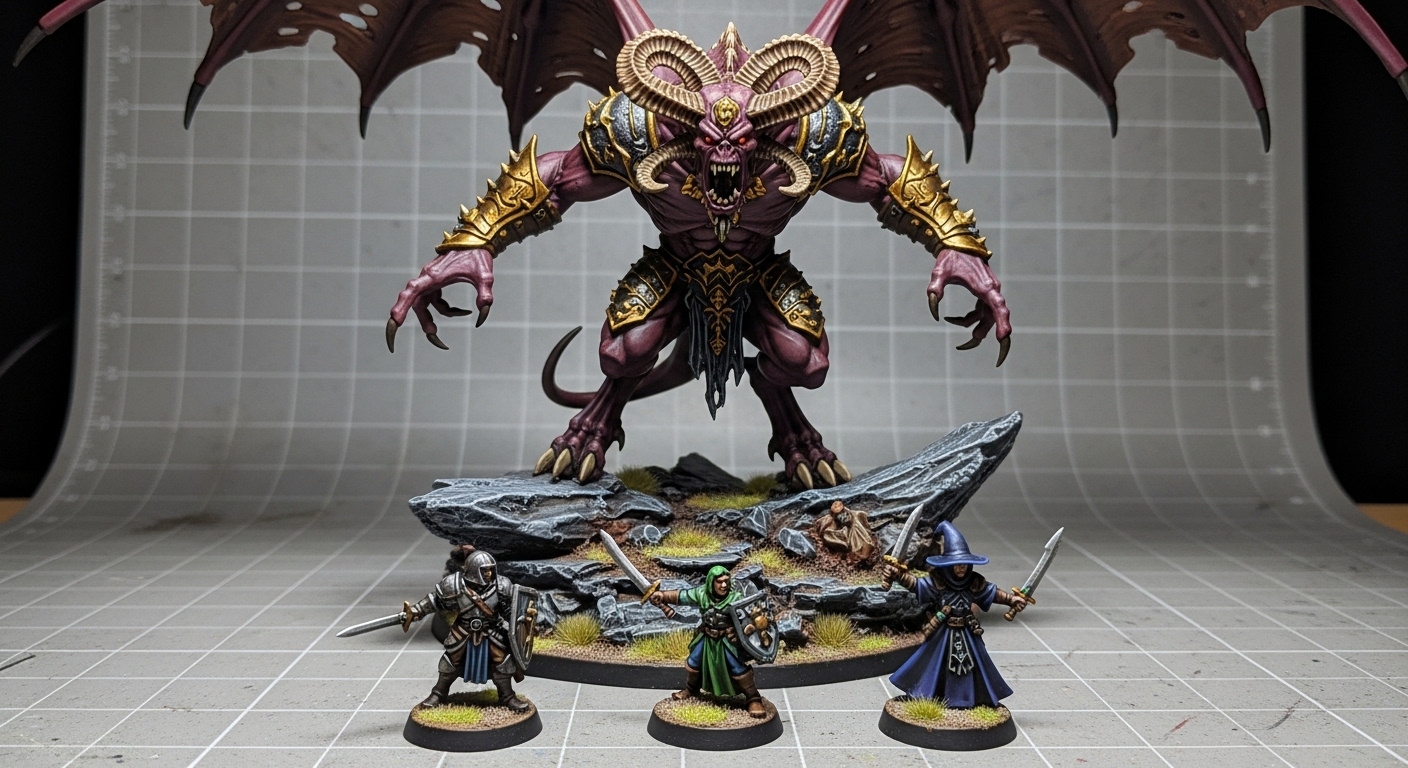
A boss monster miniature is the physical manifestation of a campaign's dramatic climax. It is the moment when the DM reaches behind the screen, places a towering 75mm figure on the battle map, and watches the table fall silent. No amount of descriptive narration can replicate the visceral impact of a sculpted demon king looming over a party of 32mm adventurers. If you are running a D&D campaign -- or any tabletop RPG -- and you are not using boss miniatures, you are leaving your most powerful storytelling tool on the shelf.
The Psychology of Scale
Standard D&D miniatures sit at 28-32mm scale -- roughly the height of a human character. At this scale, your party's fighters, wizards, and rogues feel appropriately sized relative to each other. But when a boss monster enters the scene, scale becomes a narrative weapon.
A 75mm villain miniature towers over the party at more than double their height. The size difference is immediately legible: this is not another goblin. This is the thing the entire campaign has been building toward. Players physically lean back from the table. The dynamic shifts from tactical planning to primal threat assessment.
This is not hyperbole. Cognitive psychology research on embodied cognition demonstrates that physical objects in our environment shape our emotional responses. A large, detailed, menacing figure on the table activates threat responses that flat tokens and theater-of-the-mind descriptions simply cannot. The best DMs exploit this ruthlessly.
The Art of the Dramatic Reveal
Timing is everything. Here are three techniques for deploying a boss miniature for maximum dramatic impact:
The Curtain Drop
Keep the boss miniature hidden until the exact moment the party enters the boss chamber. Use a box, a cloth, or simply keep it behind the screen. When the party crosses the threshold, place the figure on the map without a word. Let the sculpt speak for itself. The silence at the table is the payoff.
The Slow Build
Place the boss miniature on the table at the start of the session -- but at the far end of the map, behind layers of minions, traps, and terrain. The party can see the boss from the moment they enter the dungeon. Every room they clear brings them closer. The miniature becomes a gravitational center that pulls the session forward. By the time they reach it, the tension has been building for hours.
The False Summit
Place a medium-sized lieutenant figure as the apparent boss. Let the party fight it, expend resources, celebrate the kill. Then place the true boss miniature. The scale difference between a 32mm lieutenant and a 75mm demon king tells the story instantly: you thought that was the boss? The emotional whiplash is devastating and memorable.
Encounter Design Around the Miniature
A boss miniature is not just a visual prop -- it should inform the mechanics of the encounter itself. Here are principles for designing encounters that honor the miniature you have printed:
- Multi-phase fights. A 75mm demon king deserves more than one health bar. Design the encounter in phases -- when the boss drops to 50% HP, it transforms, the environment changes, and the miniature's secondary features (wings unfurling, weapons igniting) become narratively relevant.
- Minion waves. Place 32mm minion figures around the boss. The scale contrast reinforces the hierarchy -- these are servants of the boss, not its equals. Clay Cyanide's Villain Sets are designed with exactly this dynamic in mind, shipping a boss figure alongside a full retinue of scaled minions.
- Environmental interaction. If the boss miniature includes a base with terrain elements (ruins, flames, sigils), incorporate those elements into the encounter's mechanics. Asmodeus breathes fire? The flames on his base become a damage zone. Vine demolishes towers? The rubble on his base provides half cover.
- Targeted abilities. Give the boss abilities that specifically interact with the miniature's physical features. The three heads of Asmodeus can each target a different player. Paimon's musical procession can impose charm effects keyed to the musician figures in his retinue.
Choosing the Right Boss Miniature
Not all boss miniatures are created equal. When selecting a miniature for your campaign's climax, consider these factors:
- Narrative fit. The miniature should match the villain you have been foreshadowing. If your campaign's antagonist is a demon of pride and wrath, Asmodeus is a better choice than a generic dragon. The Ars Goetia provides a deep roster of thematically distinct demons, each with unique visual identities.
- Scale appropriateness. A 75mm figure dominates a standard battle map. For encounters in tight dungeon corridors, consider whether the miniature's footprint will overwhelm the play space. For open-field or throne-room battles, go as large as your printer allows.
- Print quality. Boss miniatures are the prints your players will examine most closely. Use the best resin you have, print at the highest resolution your printer supports, and take extra care with post-processing. A well-printed demon miniature is a centerpiece that players will photograph and remember for years.
- Presupport quality. Complex boss miniatures with wings, tails, and multi-figure compositions fail more often than simple models. Always use presupported STL files from studios that test across consumer printers. A failed 12-hour print the night before a session is a DM's nightmare.
Build Your Boss Roster
The best campaigns feature multiple boss encounters across a full arc -- not just the final battle, but lieutenants, rivals, and unexpected threats along the way. Building a roster of boss miniatures means you are always prepared for the moment when the story demands something towering and terrible on the map.
Browse the full Clay Cyanide catalogue to find boss-scale models for every tier of play, from mid-level duke encounters (like the Agares Villain Set) to campaign-ending demon kings (like Asmodeus and Belial). Join the Covenant on Patreon to receive new boss-quality models every month, ready to print and deploy at your table.