Gilgamesh
Gilgamesh — The Encounter
Two-Thirds-Divine King of Uruk, Tamer of the Wild · a boss your table can run with almost no prep. SRD 5.1-compatible.
Who Is Gilgamesh
Set down upon the tablets of Uruk: two parts god and one part man, the king Gilgamesh built ramparts no army could breach and wearied his own people with his boundless vigor. When the goddess of love was spurned by him, she loosed the Bull of Heaven to gore the land, yet the king and his wild brother Enkidu slew the beast and cast its haunch at her feet. Grief came for him only when death took Enkidu, and so the king crossed the waters of death seeking the secret of unending life, wrestling lions, outlasting the scorpion-folk at the world's edge, and bargaining with the flood-survivor for a thorn that restores youth, only to lose it to a serpent. He returned to Uruk emptied of his quest but full of wisdom, and bid his scribes carve his deeds in stone so that his name, if not his flesh, might never die.
Run Gilgamesh in Sixty Seconds
- He cannot be cowed. Gilgamesh is immune to frightened and auto-passes one failed save per rest (Kingly Indomitability), so don't waste fear or save-or-suck on him.
- Open with Sundering Throw. If the party clusters, the 30-foot line for 6d10 sets the tone; otherwise hold it and Roar of Uruk to frighten the front rank first.
- Kill-priority is casters. Heroic Stride lets him ignore opportunity attacks to reach the back line and grapple the controller; he'll prone the heaviest melee with the blade.
- When bloodied, he ignores the first kill. Two-Thirds Divine drops him to 1 HP instead of 0 the first time each turn, so expect a second wind and don't celebrate early.
- Three ways to run him: a scripted heroic duel, a frightening solo skirmisher with legendary actions, or a two-front brawl paired with Enkidu the Wild Brother.
Gilgamesh
Medium humanoid (human), chaotic neutral
CR 11 · 7,200 XP · GUIDELINETwo-Thirds Divine. Gilgamesh has advantage on saving throws against being charmed, paralyzed, petrified, or put to sleep, and magic cannot reduce his hit point maximum. The first time each turn he is reduced to 0 hit points, he instead drops to 1 hit point.
Kingly Indomitability. If Gilgamesh fails a saving throw, he can choose to succeed instead (recharges after he finishes a short or long rest).
Heroic Onslaught. When Gilgamesh hits a creature with a melee attack, the target has disadvantage on the next saving throw it makes against being frightened before the end of Gilgamesh's next turn.
Actions
Multiattack. Gilgamesh makes three attacks with his curved royal blade.
Curved Royal Blade. Melee Weapon Attack: +10 to hit, reach 5 ft., one target. Hit: 17 (2d10 + 6) slashing damage. If the target is a Large or smaller creature, it must succeed on a DC 16 Strength saving throw or be knocked prone.
Sundering Throw (Recharge 5-6). Gilgamesh hurls his blade in a 30-foot line, 5 feet wide. Each creature in that line must make a DC 16 Dexterity saving throw, taking 33 (6d10) slashing damage on a failed save, or half as much on a success. The blade returns to his hand at the end of the turn.
Bonus Actions & Reactions
Wrestler's Grip (Reaction). When a creature Gilgamesh can see within 5 feet hits him with a melee attack, he can grapple it (escape DC 18). A creature he is grappling this way takes 9 (2d8) bludgeoning damage at the start of each of his turns.
Legendary Actions (3/Round)
Blade Strike. Gilgamesh makes one Curved Royal Blade attack.
Heroic Stride (Costs 1 Action). Gilgamesh moves up to his speed without provoking opportunity attacks.
Roar of Uruk (Costs 2 Actions). Gilgamesh lets out a kingly war-cry. Each enemy within 30 feet must succeed on a DC 16 Wisdom saving throw or be frightened of him until the end of its next turn.
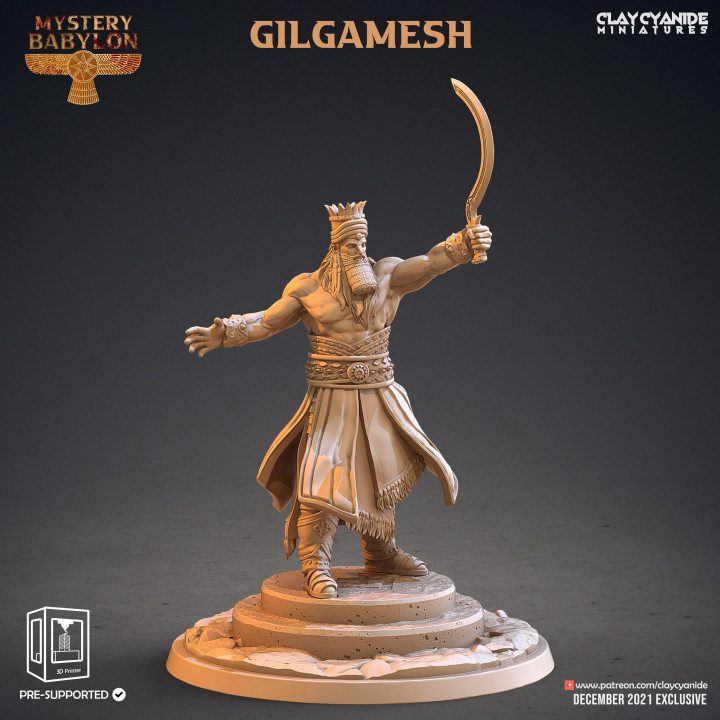
A bare-chested, mountainously muscled king crowned with a spiked diadem and a long braided beard raises a curved bronze blade toward the heavens, one hand flung wide in command as he stands atop the ziggurat steps of Uruk.
Gilgamesh, Bound
Companion · acts on your initiative
Bound · GUIDELINEUntamed Bond (signature). While within 30 feet of Gilgamesh, Gilgamesh has advantage on attack rolls against any creature that has damaged Gilgamesh since the start of Gilgamesh's last turn.
Actions
Brawling Fists. Melee Weapon Attack: +8 to hit, reach 5 ft., one target. Hit: 14 (2d8 + 5) bludgeoning damage, and the target must succeed on a DC 15 Strength saving throw or be grappled (escape DC 15).
Reactions
Shield the King. When Gilgamesh takes damage from an attack while Gilgamesh is within 5 feet of him, Gilgamesh can take that damage instead.
A shaggy, beast-strong man raised among the herds, equal to the king in strength and the only soul he ever called brother.
Guideline numbers — formula-tuned and read from the miniature's design, not yet table-proven. Tell us how it ran in the comments.
How It Fights — by Tier
Same creature, scaled threat. The traits never change; only the numbers move.
Open with Sundering Throw against a clustered party, then close to engage the squishiest caster. He is overwhelming for low tier as a true solo, so use him only as a scripted duel or scale down his Multiattack to two blows. Drop Roar of Uruk early to scatter the line.
Lead with Roar of Uruk to frighten the front rank, then wade in and prone-lock the heaviest melee threat with the blade. Use Wrestler's Grip to punish whoever hits him hardest. Spend legendary Blade Strikes on the lowest-HP target to force concentration checks.
Open with Sundering Throw down the party's tightest cluster, then Heroic Stride to the back line and grapple the controller. Kill-priority: casters and healers, since Two-Thirds Divine lets him shrug off the first knockout. Run him as a lone duelist or pair him with Enkidu for a true two-front fight.
Put Gilgamesh on the table
Download the presupported STL and run the fight tonight — the model, and the encounter that comes with it.
Get the STL on MyMiniFactory →Clay Cyanide Companion Rules v1
How a bound creature acts
- A companion acts on its owner's initiative, immediately after the owner.
- It uses the Companion block above — roughly ×0.6 HP and damage, no recharge abilities, and at most one reaction trait.
- It moves freely; it takes its Action only while its owner is conscious.
- At 0 HP a companion is broken, not dead — restored on a long rest unless your table rules otherwise.
Original Clay Cyanide material © Clay Cyanide LLC — explicitly not the non-SRD official sidekick rules.
Questions, Asked at the Table
What CR is Gilgamesh?
His native build is CR 11 (7,200 XP), tuned for a Tier 3 party of levels 11-15. As a legendary solo he plays up a band, so four characters should expect a centerpiece fight. Scaled Tier 1 and Tier 2 stat lines are provided for lower tables.
Can Gilgamesh be a companion or ally?
Yes. As a two-thirds-divine king he makes a formidable patron or temporary ally, lending his blade and his fearlessness to a cause he respects, though he chafes at taking orders. The included companion, Enkidu the Wild Brother, can instead join the party while Gilgamesh stands as the adversary.
Is Gilgamesh a spellcaster?
No. He is a pure martial powerhouse, leaning on raw strength, heroic reflexes, and his curved royal blade. His threat comes from relentless Multiattacks, line-clearing Sundering Throws, grapples, and a war-cry that frightens whole ranks, not from spells.
Tell Us How It Ran
This work includes material taken from the System Reference Document 5.1 ("SRD 5.1") by Wizards of the Coast LLC and available at dnd.wizards.com/resources/systems-reference-document. The SRD 5.1 is licensed under the Creative Commons Attribution 4.0 International License available at creativecommons.org/licenses/by/4.0/legalcode.
Clay Cyanide Miniatures is not affiliated with, endorsed, sponsored, or specifically approved by Wizards of the Coast LLC. This content is compatible with the fifth edition of the world's most popular fantasy roleplaying game. Companion rules, lore, names, and original mechanics © Clay Cyanide LLC.
Technical Specifications
32mm, 75mm
STL, Pre-supported STL
Standard or ABS-like resin, 0.05mm layer height
Yes — ready to print, optimized supports included

Played Gilgamesh at your table? Log in with your Obsidian Tavern account to leave a balance note, a war story, or a file issue — the sharpest reports get the block revised.
Log in to comment