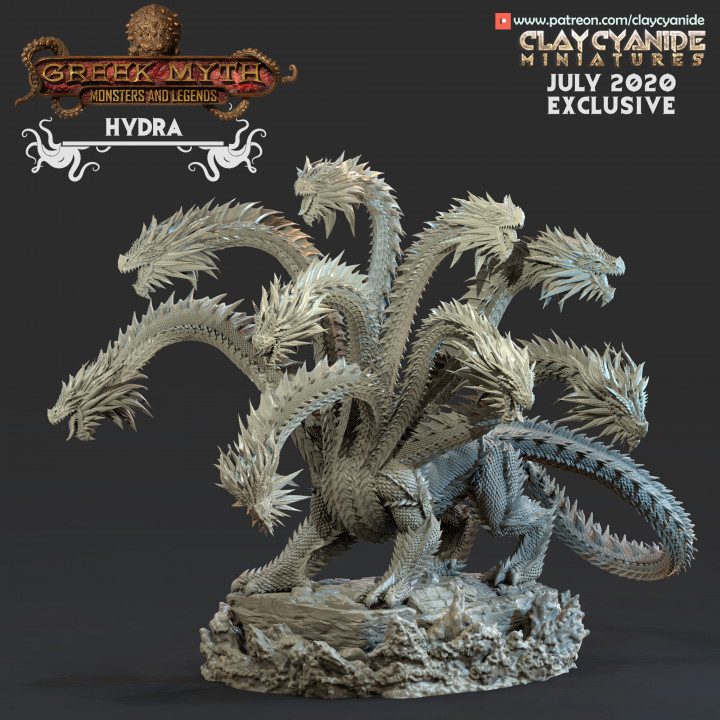
Hydra
Hydra — The Encounter
The deathless serpent of Lerna whose heads grow twofold · a boss your table can run with almost no prep. SRD 5.1-compatible.
Who Is Hydra
Of the brood of monsters whelped in the fens of Lerna, none is named with more dread than the deathless serpent. It does not hunt and it does not sleep — it merely endures, an engine of regrowth set in poisoned water where the air hangs thick and the spring runs black. Sever a head and the wound answers with two, each rising more furious than the last, so that to wound the beast is only to multiply it. The hero who would end it must learn the single secret the swamp has kept across the ages: that flame, and flame alone, seals the stumps before they can bud anew. Its breath rots the lungs; its many eyes never all close at once. Heroes beyond counting have waded the Lernaean shallows certain of victory, and the serpent has outlived every one of them, coiled and waiting at the heart of the marsh for the next.
Run Hydra in Sixty Seconds
- The whole fight is the regrowth rule. Whenever the hydra takes 25+ damage in one turn, one head dies; at end of its turn it grows two heads per head lost since its last turn — UNLESS it took fire damage. Track this out loud so players feel the stakes.
- Open by spreading the bites. With Multiattack equal to its head count, point each bite at a different PC to threaten downs everywhere, then let opportunity attacks (one per extra head via Reactive Heads) punish anyone who moves.
- Kill-priority is heads, and fire kills heads. Tell the table fire stops regrowth — that's the puzzle, not a gotcha. A party with no fire turns this into an unwinnable grind, so seed a torch, a flask of oil, or a fireball.
- When bloodied, it speeds up. Spend legendary actions on Bite to finish a downed PC, or Lashing Coils to prone a cluster; the more heads alive, the more reactions it has, so the party must shrink its head count fast.
- Three ways to run it: as a low-tier juvenile (2-3 heads, give them the fire hint), as a quest-boss centerpiece (standard, solo), or as a mythic terror (full eight heads, all legendary actions, fire-or-die).
Hydra
Huge monstrosity, unaligned
CR 9 · 5,000 XP · GUIDELINEHold Breath. The hydra can hold its breath for 1 hour.
Multiple Heads. The hydra has seven heads. While it has more than one head, it has advantage on saving throws against being blinded, charmed, deafened, frightened, stunned, and knocked unconscious. Whenever the hydra takes 25 or more damage in a single turn, one of its heads dies. If all its heads die, the hydra dies. At the end of its turn, it grows two heads for each of its heads that died since its last turn, unless it has taken fire damage since its last turn. The hydra regains 10 hit points for each head regrown in this way.
Reactive Heads. For each head the hydra has beyond one, it gets an extra reaction that can be used only for opportunity attacks.
Wakeful. (Signature) While the hydra sleeps, at least one of its heads is awake. Poison and the black waters of Lerna cling to it: a creature that ends its turn within 5 ft. of the hydra and is below half its hit point maximum must succeed on a DC 16 Constitution save or take 7 (2d6) poison damage from the fumes rising off its hide.
Actions
Multiattack. The hydra makes as many bite attacks as it has heads.
Bite. Melee Weapon Attack: +8 to hit, reach 10 ft., one target. Hit: 10 (1d10 + 5) piercing damage.
Legendary Actions (3/Round)
Detect. The hydra makes a Wisdom (Perception) check.
Bite. The hydra makes one bite attack.
Lashing Coils (Costs 2 Actions). The hydra sweeps its serpentine necks in every direction. Each creature within 10 ft. must succeed on a DC 16 Dexterity saving throw or take 9 (2d8) bludgeoning damage and be knocked prone.
Eight individually sculpted necks erupt from a coiled draconic body, every jaw agape over the black waters of a Lernaean spring. No two heads are mirrored — the model captures the serpent at the instant of maximum threat, striking outward in all directions at once.
Hydra, Bound
Companion · acts on your initiative
Bound · GUIDELINETwin Regrowth (signature). When the hatchling drops below half its hit point maximum for the first time in a fight, it regains 15 hit points at the end of its next turn unless it has taken fire damage since its last turn.
Actions
Snapping Bite. Melee Weapon Attack: +6 to hit, reach 10 ft., one target. Hit: 13 (2d8 + 4) piercing damage.
Reactions
Venom Spit. When a creature it can see within 30 ft. hits the hatchling's bound ally, the hatchling spits venom at the attacker, who must succeed on a DC 14 Constitution save or take 7 (2d6) poison damage.
A young serpent of three necks, leashed to a marsh-witch's will until fire teaches it which heads to keep.
Guideline numbers — formula-tuned and read from the miniature's design, not yet table-proven. Tell us how it ran in the comments.
How It Fights — by Tier
Same creature, scaled threat. The traits never change; only the numbers move.
Run it as a two- or three-headed juvenile so a low party can survive. Open by spreading the bites across separate targets to threaten downs; if the party clusters, use Lashing Coils to knock them prone. Tell players plainly that fire stops the heads from regrowing — withholding that here just kills the table.
This is the standard heroic-quest hydra: a centerpiece, no other monsters needed. Open by biting the squishiest casters, and lean on Multiple Heads so any chip damage that isn't 25+ in a single turn just feeds regrowth. Kill-priority for the party is a focused fire source; if they have none, the fight becomes a grind that ends in their favor only when heads die faster than they bud.
The full eight-headed terror, solo and legendary. Open with a full Multiattack to spike one PC toward death, then spend legendary Bites on whoever the healers just stabilized. When bloodied, the regrowth math turns brutal — every non-fire turn that fails to deal 25+ damage hands it two new heads and 10 HP each. Make the fight a race: the party must burn heads with fire faster than it regrows them, or lose.
Put Hydra on the table
Download the presupported STL and run the fight tonight — the model, and the encounter that comes with it.
Get the STL on MyMiniFactory →Clay Cyanide Companion Rules v1
How a bound creature acts
- A companion acts on its owner's initiative, immediately after the owner.
- It uses the Companion block above — roughly ×0.6 HP and damage, no recharge abilities, and at most one reaction trait.
- It moves freely; it takes its Action only while its owner is conscious.
- At 0 HP a companion is broken, not dead — restored on a long rest unless your table rules otherwise.
Original Clay Cyanide material © Clay Cyanide LLC — explicitly not the non-SRD official sidekick rules.
Questions, Asked at the Table
What CR is Hydra?
Its native sheet is CR 9 (5,000 XP) as a solo, legendary centerpiece for levels 11-15 — the band-drop reflects how the regrowth engine and legendary actions let it play up. Tier 1 (levels 1-4) and Tier 2 (levels 5-10) downscaled blocks are provided, and you can push it past CR 11 by adding heads and a lair.
Can Hydra be a companion or ally?
The hydra itself is a solo monstrosity, but the bound stat block — Lernaean Hatchling, Bound — gives you a leashed three-necked juvenile (AC 14, 118 HP) with Twin Regrowth and a Venom Spit reaction, suitable as a swamp-witch's guardian or a summoned ally.
How do I keep the hydra from being unkillable at my table?
Make sure the party has a reliable fire source and tell them out loud that fire stops the heads from regrowing — this is folklore, not a secret. Without fire the fight is a grind by design; with it, every 25-damage burst that includes flame permanently removes a head.
Tell Us How It Ran
This work includes material taken from the System Reference Document 5.1 ("SRD 5.1") by Wizards of the Coast LLC and available at dnd.wizards.com/resources/systems-reference-document. The SRD 5.1 is licensed under the Creative Commons Attribution 4.0 International License available at creativecommons.org/licenses/by/4.0/legalcode.
Clay Cyanide Miniatures is not affiliated with, endorsed, sponsored, or specifically approved by Wizards of the Coast LLC. This content is compatible with the fifth edition of the world's most popular fantasy roleplaying game. Companion rules, lore, names, and original mechanics © Clay Cyanide LLC.
The Legend
In Your Campaign
CR Range: 8 (standard) to 17+ (scaled mythic encounter)
Encounter Design: The Hydra excels as a multi-phase boss fight. Each head can target a different player, forcing the party to coordinate their attacks. Pair with difficult terrain (swamp, shallow water) to limit mobility. The regeneration mechanic rewards creative problem-solving — fire damage, cauterization, environmental hazards.
Campaign Hooks: Guardian of an ancient temple. A bounty that adventuring guilds consider a death sentence. The pet of a swamp hag who feeds it intruders. The final test in a gladiatorial arena.
Technical Specifications
32mm, 75mm
STL, Pre-supported STL
Standard or ABS-like resin, 0.05mm layer height
Yes — ready to print, optimized supports included
From the Same Collection


Frequently Asked Questions
How many heads does the Clay Cyanide Hydra miniature have?
The sculpt features multiple heads in dynamic poses, each individually sculpted with unique expressions and scale patterns. The exact count varies by configuration — check the product page for assembly options.
What base size does the Hydra fit on?
At 32mm scale, the Hydra occupies a Huge (3x3) base. At 75mm display scale, it spans approximately 6-7 inches across.
Is the Hydra miniature presupported?
Yes. Both supported and unsupported STL files are included. The presupported version is optimized for resin printing at 0.05mm layer height.
Played Hydra at your table? Log in with your Obsidian Tavern account to leave a balance note, a war story, or a file issue — the sharpest reports get the block revised.
Log in to comment