Lancelot
Lancelot — The Encounter
Foremost Knight of the Round, who loved past his oath · a boss your table can run with almost no prep. SRD 5.1-compatible.
Who Is Lancelot
Set down in the chronicles of the Round Table, Lancelot du Lac is named the foremost of all knights errant, unmatched at lance and blade, raised in faerie waters and tempered in tourney blood. No champion stood against him and kept his seat; no quest was set he did not ride to its end. Yet the same hand that defended the realm undid it, for he gave his heart to his lord's own queen, and love proved the one foe his sword could not unhorse. When the secret broke into open war, the fellowship of the Round Table was sundered, brother turning upon brother across fields he had once kept safe. He is remembered as the greatest of knights and the breaker of the greatest peace, a man who chose, knew the cost, and rode out anyway. In battle he fights as one already condemned, courteous to the last, refusing to fall until his debt of honor is paid in full.
Run Lancelot in Sixty Seconds
- Open mounted. Move 20+ ft. straight in and hit: Mounted Charge adds 4d6 and forces a DC 16 Strength save or prone. Lead with this every fight; a downed front-liner sets up his crit-fishing Multiattack.
- Kill-priority is mobility, his and theirs. He wants to wheel the charger and pick targets. Players who restrain or grapple him gut his whole kit, so he should kill or push casters off their control spells first.
- When bloodied, he cannot be cleanly dropped. Oathbroken Resolve catches the first lethal hit at 1 HP and hands him a free reaction swing. Tell players: chip him to bloodied, eat the rebound, THEN finish.
- Three ways to run him. As a lone duelist (dismount, all Parry and Multiattack), as a cavalry boss (lean on Wheel the Charger and trample), or as a captain (spend Rally the Round to buff a wing of knights). Pick one before initiative.
- Use Knight's Parry on the scariest incoming hit. +3 AC can turn a crit into a miss and gives him a free 10-ft. reposition; save it for the rogue's Sneak Attack or the smite, not the first arrow.
Lancelot
Medium humanoid (human), lawful good (oathbroken)
CR 11 · 7,200 XP · GUIDELINEPeerless Swordsman. Lancelot has advantage on melee attack rolls against any creature that has already taken a turn this combat. When he hits a creature with his greatsword, he scores a critical hit on a roll of 19 or 20.
Mounted Charge. If Lancelot moves at least 20 ft. straight toward a target while mounted and then hits it with a melee attack on the same turn, the target takes an extra 14 (4d6) damage and must succeed on a DC 16 Strength save or be knocked prone.
Oathbroken Resolve. Signature. The first time each turn Lancelot would be reduced to 0 hit points or below, he is instead reduced to 1 hit point if he is below half his hit points, and he immediately makes one greatsword attack as a reaction. The shame of his broken vow lets nothing fell him before he has answered for it.
Actions
Multiattack. Lancelot makes three greatsword attacks, or two greatsword attacks and one Shield Bash.
Greatsword. Melee Weapon Attack: +9 to hit, reach 5 ft., one target. Hit: 16 (2d10 + 5) slashing damage.
Shield Bash. Melee Weapon Attack: +9 to hit, reach 5 ft., one target. Hit: 9 (1d6 + 5) bludgeoning damage, and the target must succeed on a DC 16 Strength save or be pushed 10 ft. and knocked prone.
Bonus Actions & Reactions
Knight's Parry (Reaction). When a creature Lancelot can see hits him with a melee attack, he adds 3 to his AC against that attack, potentially causing it to miss. If it misses, he may immediately move up to 10 ft. without provoking opportunity attacks.
Legendary Actions (3/Round)
Sword Stroke. Lancelot makes one greatsword attack.
Wheel the Charger (Costs 1 Action). Lancelot's mount moves up to its speed without provoking opportunity attacks. If it passes within 5 ft. of a hostile creature, that creature must succeed on a DC 16 Dexterity save or take 7 (2d6) bludgeoning damage from trampling hooves.
Rally the Round (Costs 2 Actions). Lancelot raises his blade. He and each allied creature within 30 ft. that can see him gains 11 temporary hit points and has advantage on its next attack roll before the start of his next turn.
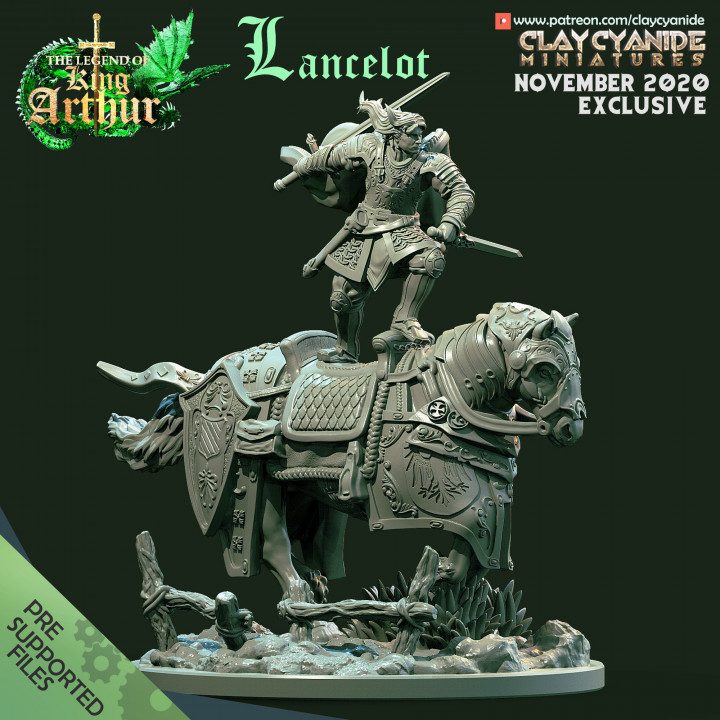
Sculpted in full battle glory atop a heavily barded charger, Lancelot rises in his stirrups with sword raised in certainty rather than challenge, his plate etched with the heraldry of a man who has nothing left to prove.
Lancelot, Bound
Companion · acts on your initiative
Bound · GUIDELINESure-Footed (signature). The charger has advantage on saving throws against being knocked prone, and difficult terrain made of rubble or undergrowth does not cost it extra movement.
Actions
Hooves. Melee Weapon Attack: +7 to hit, reach 5 ft., one target. Hit: 13 (2d8 + 4) bludgeoning damage. If the charger moved at least 20 ft. straight toward the target, the target makes a DC 15 Strength save or is knocked prone.
Reactions
Shield the Rider. When its rider is hit by an attack, the charger may interpose, taking half the damage itself.
A destrier in full plate barding, bred and trained to thunder unflinching into a wall of spears so its knight may strike from the saddle.
Guideline numbers — formula-tuned and read from the miniature's design, not yet table-proven. Tell us how it ran in the comments.
How It Fights — by Tier
Same creature, scaled threat. The traits never change; only the numbers move.
Run him dismounted as a lone champion duelist. Open with a single Greatsword on the squishiest front-liner, then use Knight's Parry to shrug the first big hit. Drop Mounted Charge and Rally the Round at this scale; he is a clean elite, not a boss.
Open mounted: charge the back line, knock the caster prone, then Multiattack. Kill-priority is whoever can lock him down (web, hold) since he relies on movement. Pair him with 2-3 lesser knights or use the charger as a second body so he is not focus-fired alone.
Open with a 20-ft. Mounted Charge into the heaviest melee threat: extra 4d6 plus a prone knockdown, then Multiattack with crit-on-19. Spend legendary Sword Strokes on whoever drops below half. When bloodied, Oathbroken Resolve refuses the killing blow once; bait it out before committing your nova. Kill-priority for the party: lock his movement, then burst through Knight's Parry.
Put Lancelot on the table
Download the presupported STL and run the fight tonight — the model, and the encounter that comes with it.
Get the STL on MyMiniFactory →Clay Cyanide Companion Rules v1
How a bound creature acts
- A companion acts on its owner's initiative, immediately after the owner.
- It uses the Companion block above — roughly ×0.6 HP and damage, no recharge abilities, and at most one reaction trait.
- It moves freely; it takes its Action only while its owner is conscious.
- At 0 HP a companion is broken, not dead — restored on a long rest unless your table rules otherwise.
Original Clay Cyanide material © Clay Cyanide LLC — explicitly not the non-SRD official sidekick rules.
Questions, Asked at the Table
What CR is Lancelot?
His home statline is CR 11 (Tier 3, ~levels 11-15), and he is built solo-capable: the legendary actions and Oathbroken Resolve let him headline an encounter for a party of four at that level. The provided Tier 1 and Tier 2 lines down-rank him to a CR 2 elite or a CR 6 mounted threat with the exact same traits, only the numbers moving.
Can Lancelot be a companion or ally?
Yes. As the greatest knight of the Round Table he makes a natural sworn champion or quest-giver: run him with his barded charger statblock as a temporary ally, or strip the legendary actions and use the Tier 1 line as a recurring NPC bodyguard. His broken oath gives him a built-in reason to seek redemption alongside the party.
Is Lancelot's mount its own creature?
It can be either. The companion block (Barded Charger) lets the destrier act on its own initiative with hooves, Sure-Footed, and a damage-sharing reaction, or you can fold it into Lancelot purely as the source of his Mounted Charge and Wheel the Charger for a single, simpler boss turn.
Tell Us How It Ran
This work includes material taken from the System Reference Document 5.1 ("SRD 5.1") by Wizards of the Coast LLC and available at dnd.wizards.com/resources/systems-reference-document. The SRD 5.1 is licensed under the Creative Commons Attribution 4.0 International License available at creativecommons.org/licenses/by/4.0/legalcode.
Clay Cyanide Miniatures is not affiliated with, endorsed, sponsored, or specifically approved by Wizards of the Coast LLC. This content is compatible with the fifth edition of the world's most popular fantasy roleplaying game. Companion rules, lore, names, and original mechanics © Clay Cyanide LLC.
The Legend
In Your Campaign
CR Range: 12-15 (legendary knight / fallen paladin)
Encounter Design: Lancelot works as an ally-turned-rival, a tragic boss fight where the party knows he's right but must stop him anyway. Give him legendary actions, a mount, and a code of honor that prevents him from fighting dirty — then make the party face the moral weight of defeating someone who's fighting fairly.
Campaign Hooks: A legendary knight who guards a bridge and challenges all who pass. The champion of a queen wrongly accused. A fallen paladin seeking redemption through an impossible quest.
Technical Specifications
32mm, 75mm
STL, Pre-supported STL
Standard or ABS-like resin, 0.05mm layer height
Yes — ready to print, optimized supports included
From the Same Collection
Frequently Asked Questions
Why does Lancelot have the highest engagement ratio?
With 1,753 likes on 43,900 views (4% engagement), Lancelot resonates deeply with the community. The combination of Arthurian legend, exceptional sculpt detail, and dynamic pose makes it one of the most-loved models in the catalog.
Is Lancelot suitable as a D&D player character miniature?
Yes — Lancelot works perfectly as a paladin, fighter, or oath-of-devotion character. The sculpt conveys both martial prowess and emotional depth.
Does Lancelot come with a mount option?
Check the product page for available configurations. Clay Cyanide frequently offers mounted and unmounted variants for knight characters.
Played Lancelot at your table? Log in with your Obsidian Tavern account to leave a balance note, a war story, or a file issue — the sharpest reports get the block revised.
Log in to comment