Medusa
Medusa — The Encounter
The Gorgon whose gaze turns the bold to cold stone · a boss your table can run with almost no prep. SRD 5.1-compatible.
Who Is Medusa
Know her by the temples that fell silent. She was once a votary of beauty, the tale says, until a violation in a sacred place earned her a goddess's cruel mercy: her tresses became serpents, her gaze a sentence, that no man might ever desire her again unpunished. The priests carved warnings in the old tongue and walled her grotto with the statues of those who came to slay her and stayed forever as garden ornaments. She is no mindless beast. She speaks, she bargains, she remembers each face that turned away in time. Heroes who survive her speak less of the serpents than of the moment their own feet would not move, their own knees grew heavy as marble, while she slithered close and smiled. Approach her lair and you will pass the petrified: arms raised, mouths open in a scream that never came. They are her congregation now, and the silence they keep is the only prayer she answers.
Run Medusa in Sixty Seconds
- Gaze first, blade second. Every round, before her attacks, fire Petrifying Gaze at whoever is NOT already saving. The threat of stone is her real weapon; the glaive just finishes statues.
- Kill-priority for the party is line of sight. Anyone who can blind her, fog the room, or grant save-advantage neutralizes her. She should target those PCs first with Snake Hair and legendary Snap.
- When bloodied, go vertical and visual. Slither in among the petrified victims so PCs must look at her (re-triggering gaze) to attack, and use Coiled Retreat to break melee.
- Three ways to run her: as a lair-guarding solo boss with legendary actions (native T2), as a paired lieutenant beside a bigger serpent-cult flagship (drop legendary actions), or as a skill-challenge hazard where surviving her gaze long enough to reach an exit IS the encounter.
Medusa
Medium monstrosity, lawful evil
CR 8 · 3,900 XP · GUIDELINEPetrifying Gaze. When a creature that can see the gorgon's eyes starts its turn within 30 ft. of her, she can force it to make a DC 14 Constitution save if she is not incapacitated and can see the creature. On a failure the target is restrained as its flesh begins to harden; it repeats the save at the end of its next turn, becoming petrified on a second failure or ending the effect on a success. A creature can avert its eyes to avoid the save, taking disadvantage on attacks against her until its next turn; if it then looks at her, it must immediately save.
Snake Crown. The living serpents of her hair watch every angle. The gorgon cannot be surprised and has advantage on Wisdom (Perception) checks that rely on sight.
Actions
Multiattack. The gorgon makes one Glaive attack and one Snake Hair attack. If a creature is petrified or restrained by her gaze, she can replace the Glaive attack with a second Snake Hair attack.
Glaive. Melee Weapon Attack: +6 to hit, reach 10 ft., one target. Hit: 17 (3d8+3) slashing damage.
Snake Hair. Melee Weapon Attack: +6 to hit, reach 5 ft., one target. Hit: 8 (2d4+3) piercing damage plus 9 (2d8) poison damage.
Bonus Actions & Reactions
Serpentine Slither. Reaction. When a creature she can see ends its movement within 10 ft. of her, the gorgon may make one Snake Hair attack against it.
Legendary Actions (3/Round)
Snap (Costs 1 Action). The gorgon makes one Snake Hair attack.
Coiled Retreat (Costs 1 Action). The gorgon moves up to her speed without provoking opportunity attacks.
Catch the Eye (Costs 2 Actions). The gorgon forces one creature she can see within 30 ft. to make a DC 14 Constitution save against her Petrifying Gaze, even on another creature's turn.
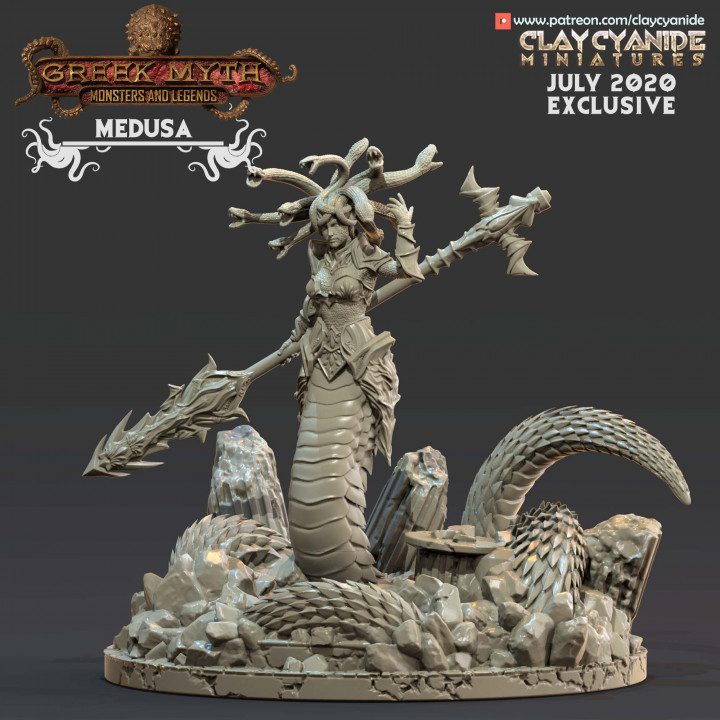
Coiled atop a field of shattered crystal stands the Gorgon: a scaled serpent where her legs should be, a crown of hissing vipers framing a beautiful, terrible face, a great bladed glaive held ready in both hands.
Medusa, Bound
Companion · acts on your initiative
Bound · GUIDELINEStone-Touched Skin (signature). Medusa is immune to being petrified and has advantage on saves against being restrained. Once per turn, when an ally within 30 ft. fails a save against a petrifying effect, Medusa can grant it a reroll.
Actions
Stone Spear. Melee Weapon Attack: +5 to hit, reach 10 ft., one target. Hit: 13 (2d8+4) piercing damage.
Reactions
Mirror Shield. Reaction. When an ally she can see within 10 ft. is forced to make a save against a gaze effect, Medusa angles her polished shield to give that ally advantage on the save.
A lesser sister of the gorgon-line, sworn to guard travelers, whose own scaled skin has learned to shrug off the curse that defines her kin.
Guideline numbers — formula-tuned and read from the miniature's design, not yet table-proven. Tell us how it ran in the comments.
How It Fights — by Tier
Same creature, scaled threat. The traits never change; only the numbers move.
Open with Petrifying Gaze on the front-line tank so the party must choose between attacking and averting their eyes. If the party clusters, lash with Snake Hair and Serpentine Slither to punish anyone who closes. Kill-priority is whoever can shatter petrified allies; at this tier run her as a lair guardian and let the statues do the intimidating.
Open by forcing a gaze save on the strongest melee threat, then glaive a caster from 10 ft. Spend legendary actions on Catch the Eye to keep two PCs locked in saves while you snap and reposition. When bloodied, retreat among the petrified statues so attackers must look at you (and the gaze) to engage; this is her solo boss home tier with legendary actions.
Open Catch the Eye on two casters before initiative settles, then glaive the one who saved. Use Coiled Retreat every round so blasters can never pin you in the open. Kill-priority is any source of advantage on saves or freedom-of-movement; pair her with a swarm of stone-skinned guardians so the party cannot simply avert and rush past.
Put Medusa on the table
Download the presupported STL and run the fight tonight — the model, and the encounter that comes with it.
Get the STL on MyMiniFactory →Clay Cyanide Companion Rules v1
How a bound creature acts
- A companion acts on its owner's initiative, immediately after the owner.
- It uses the Companion block above — roughly ×0.6 HP and damage, no recharge abilities, and at most one reaction trait.
- It moves freely; it takes its Action only while its owner is conscious.
- At 0 HP a companion is broken, not dead — restored on a long rest unless your table rules otherwise.
Original Clay Cyanide material © Clay Cyanide LLC — explicitly not the non-SRD official sidekick rules.
Questions, Asked at the Table
What CR is Medusa?
Her native build is CR 8 (3,900 XP), a Tier 2 solo boss for parties of levels 5-10. Because she has legendary actions and a battlefield-locking gaze, her sheet drops one band so she plays up a level or two as a centerpiece. Scale her to CR ~2 for Tier 1 or CR ~13 for Tier 3 using the tier table; traits stay identical, only the numbers move.
Can Medusa be a companion or ally?
The gorgon herself is built as an adversary and boss, but the record includes Sthenra, Bound - a stone-skinned lesser gorgon allied to travelers who can be run as an NPC ally or sidekick. Sthenra grants reroll support against petrification and shields allies from gaze effects, making her a natural counter to a hostile Medusa or any statue-making horror.
How do players survive the Petrifying Gaze?
Averting their eyes lets them skip the save but imposes disadvantage on their attacks against her, so most fights become a tug-of-war between safety and damage. Effects that blind Medusa, obscure the battlefield (fog, darkness against creatures that can't see), or grant advantage on Constitution saves are the real counters - and greater restoration or a basilisk's-blood remedy can reverse a petrified ally before the fight ends.
Tell Us How It Ran
This work includes material taken from the System Reference Document 5.1 ("SRD 5.1") by Wizards of the Coast LLC and available at dnd.wizards.com/resources/systems-reference-document. The SRD 5.1 is licensed under the Creative Commons Attribution 4.0 International License available at creativecommons.org/licenses/by/4.0/legalcode.
Clay Cyanide Miniatures is not affiliated with, endorsed, sponsored, or specifically approved by Wizards of the Coast LLC. This content is compatible with the fifth edition of the world's most popular fantasy roleplaying game. Companion rules, lore, names, and original mechanics © Clay Cyanide LLC.
The Legend
In Your Campaign
Source Mythology: Medusa draws from ancient mythological traditions, bringing legendary power to your tabletop.
Encounter Design: Use Medusa as a divine patron, a mythic boss encounter, or the centerpiece of a mythology-themed campaign arc. The model's dynamic pose creates immediate dramatic tension at the table.
Campaign Hooks: An ancient temple awakens. A prophecy names Medusa as either savior or destroyer. A cult seeks to summon or bind this mythological power for mortal purposes.
Technical Specifications
32mm, 75mm
STL, Pre-supported STL
Standard or ABS-like resin, 0.05mm layer height
Yes — ready to print, optimized supports included
From the Same Collection

Frequently Asked Questions
What scale is the Medusa miniature available in?
Medusa is available in 32mm (tabletop standard) and 75mm (display/collector scale). Both scale files are included with presupported and unsupported STL options.
Is the Medusa STL file presupported?
Yes. Every Clay Cyanide miniature includes presupported STL files optimized for resin printing at 0.05mm layer height, plus unsupported files for custom support placement.
Can I use Medusa in my D&D or tabletop RPG campaign?
Absolutely. Medusa is designed for tabletop gaming at 32mm scale, fitting standard grid-based combat systems. The dynamic pose and detailed sculpt create memorable encounters and character moments.
Played Medusa at your table? Log in with your Obsidian Tavern account to leave a balance note, a war story, or a file issue — the sharpest reports get the block revised.
Log in to comment