Mordred
Mordred — The Encounter
The Traitor Knight, Doom of the Round Table · a boss your table can run with almost no prep. SRD 5.1-compatible.
Who Is Mordred
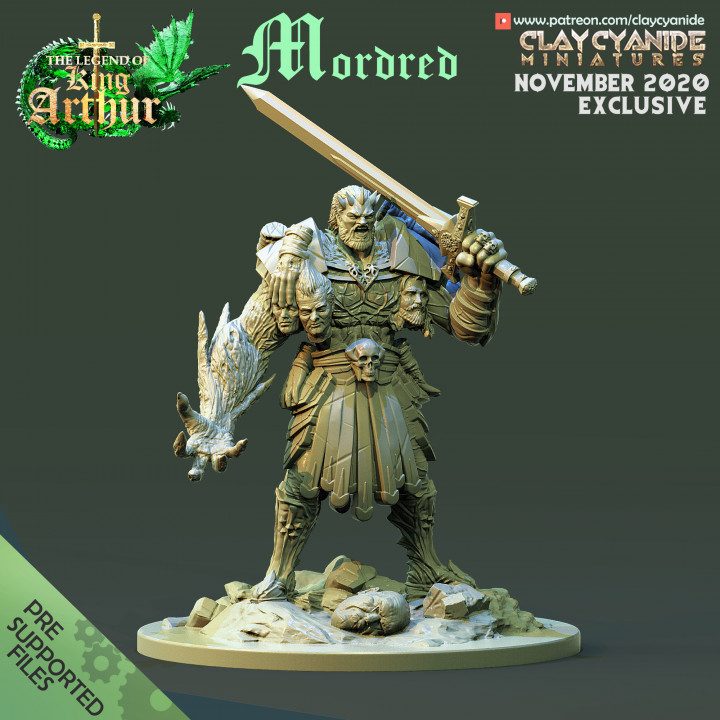
Born of treachery and raised on resentment, Mordred stands as the knife hidden within the kingdom he was sworn to serve. Where other knights of the old fellowship pledged faith, he learned only that faith is a thing to be spent. The faces bound to his armor are those who trusted him last; the skull at his hip whispers the names of kings undone by ambition. When the great realm of Britain fractured, it was his blade that struck the final, mortal wound into the heart of its lord, and his treason that scattered the company of the round. He fights without honor and without retreat, for a man who has already damned his own house has nothing left to lose. To meet Mordred upon the field is to face the moment a golden age ended, given armor and a sword, grinning beneath the weight of every oath he ever broke.
Run Mordred in Sixty Seconds
- Open with the skull. Hurled Trophy Skull is his opener whenever two or more PCs cluster: 4d6 psychic plus frightened scatters formations and softens the alpha strike.
- Kill-priority: healers and buffers. Oathbreaker's Spite gives advantage against anyone he hit last round, so commit to one target and keep grinding the same throat.
- When bloodied, he gets WORSE. Below half hit points he adds +3 to every melee hit; warn players that backing off won't save them and the riposte still bites.
- Treacherous Riposte taxes melee. Every missed melee swing within reach earns a free greatsword counter, so reward ranged kiting and punish wade-in tanks.
- Three ways to run him. Front-rank breaker with mooks (T1), elite knight beside a flagship monster (T2 native), or the boss's loyal champion-bodyguard the party must clear first (T3).
Mordred
Medium humanoid (human), lawful evil
CR 6 · 2,300 XP · GUIDELINEBrutal Greatsword. Mordred's greatsword scores a critical hit on a roll of 19 or 20. When he reduces a creature to 0 hit points with a melee attack, he can move up to 10 feet without provoking opportunity attacks.
Oathbreaker's Spite. Signature. Mordred has advantage on attack rolls against any creature he has hit since the start of his last turn. While below half his hit points, he also adds +3 damage to all melee hits, fighting with a betrayer's reckless fury.
Actions
Multiattack. Mordred makes two greatsword attacks.
Greatsword. Melee Weapon Attack: +7 to hit, reach 5 ft., one target. Hit: 11 (2d6+4) slashing damage.
Hurled Trophy Skull (Recharge 5-6). Mordred flings a screaming spirit-bound skull at a point he can see within 30 feet. Each creature within 10 feet of that point must make a DC 14 Wisdom saving throw, taking 14 (4d6) psychic damage on a failed save and becoming frightened of Mordred until the end of its next turn, or half as much damage and no fright on a success.
Bonus Actions & Reactions
Treacherous Riposte. Reaction. When a creature within 5 feet misses Mordred with a melee attack, he makes one greatsword attack against it.
Sculpted in heavy infernal-grey plate with a falcon perched on his fist, Mordred hoists a greatsword the length of a man, the severed faces of betrayed kinsmen lashed to his armor and a spirit-skull dangling at his belt.
Mordred, Bound
Companion · acts on your initiative
Bound · GUIDELINECarrion Eyes (signature). While Mordred perches within 10 feet of an ally, that ally gains advantage on attack rolls against any creature the falcon attacked since the start of the ally's last turn.
Actions
Talons. Melee Weapon Attack: +5 to hit, reach 5 ft., one target. Hit: 9 (2d6+2) slashing damage, and the target's vision is harried, giving it disadvantage on its next attack roll.
Reactions
Screech of Ill Omen. Reaction. When an ally within 20 feet is hit by an attack, Mordred screeches; the attacker must succeed on a DC 13 Wisdom save or be frightened until the end of its next turn.
A pale hunting bird bound to its master's cruelty, Mordred marks prey for the traitor's blade and unnerves the brave with its mournful cry.
Guideline numbers — formula-tuned and read from the miniature's design, not yet table-proven. Tell us how it ran in the comments.
How It Fights — by Tier
Same creature, scaled threat. The traits never change; only the numbers move.
Open by hurling the trophy skull into the densest knot of the party to scatter and frighten them, then wade into the weakest-looking caster with both greatsword swings. Treacherous Riposte punishes any melee fighter who closes; let them come. Pair him with a banner-bearer or cultist line so he is the heavy that breaks the front rank, not a lone duelist.
Open on the squishiest target with Multiattack and Oathbreaker's Spite advantage, then keep hitting the same creature to chain that advantage. Kill-priority is anyone who heals or buffs; the skull throw resets a clustered party every other round. He is the elite knight piece beside a bigger threat (a dragon, a giant, or a flagship boss) rather than the centerpiece himself, so use him to lock down the melee while the larger threat rules the air or the back line.
At high tier he is a relentless skirmisher: open with the skull to frighten the cluster, then carve through whoever he hit last for the Spite advantage. Below half hit points his +3 reckless damage makes him deadliest exactly when players think they've won. Slot him as the bodyguard-champion flanking a true legendary boss so the party cannot focus the boss without first dealing with the traitor's blade.
Put Mordred on the table
Download the presupported STL and run the fight tonight — the model, and the encounter that comes with it.
Get the STL on MyMiniFactory →Clay Cyanide Companion Rules v1
How a bound creature acts
- A companion acts on its owner's initiative, immediately after the owner.
- It uses the Companion block above — roughly ×0.6 HP and damage, no recharge abilities, and at most one reaction trait.
- It moves freely; it takes its Action only while its owner is conscious.
- At 0 HP a companion is broken, not dead — restored on a long rest unless your table rules otherwise.
Original Clay Cyanide material © Clay Cyanide LLC — explicitly not the non-SRD official sidekick rules.
Questions, Asked at the Table
What CR is Mordred?
Natively CR 6 (Tier 2, ~levels 5-10): AC 17, 127 HP, +7 to hit, DC 14. The block scales down to a CR 2-ish bruiser for Tier 1 (levels 1-4) and up toward CR 11 for Tier 3 (levels 11-15) using the numbers in the tier table; the traits and actions stay identical, only the values move.
Can Mordred be a companion or ally?
He works far better as an antagonist, but a grim, morally-gray campaign can field him as a temporary ally-of-convenience: a disgraced knight who fights beside the party only as long as their goals align, certain to turn the moment betrayal serves him. His bound falcon Cynbel makes a more comfortable companion if you want the flavor without the treachery.
Is Mordred a solo boss on his own?
No. He has no legendary actions, so an action-economy party will swarm him. He shines as an add-on: an elite knight or champion-bodyguard paired with a larger flagship threat. If you must run him solo, give him 2-3 men-at-arms or run him at the next tier up so his durability keeps pace.
Tell Us How It Ran
This work includes material taken from the System Reference Document 5.1 ("SRD 5.1") by Wizards of the Coast LLC and available at dnd.wizards.com/resources/systems-reference-document. The SRD 5.1 is licensed under the Creative Commons Attribution 4.0 International License available at creativecommons.org/licenses/by/4.0/legalcode.
Clay Cyanide Miniatures is not affiliated with, endorsed, sponsored, or specifically approved by Wizards of the Coast LLC. This content is compatible with the fifth edition of the world's most popular fantasy roleplaying game. Companion rules, lore, names, and original mechanics © Clay Cyanide LLC.
Technical Specifications
32mm, 75mm
STL, Pre-supported STL
Standard or ABS-like resin, 0.05mm layer height
Yes — ready to print, optimized supports included

Played Mordred at your table? Log in with your Obsidian Tavern account to leave a balance note, a war story, or a file issue — the sharpest reports get the block revised.
Log in to comment